

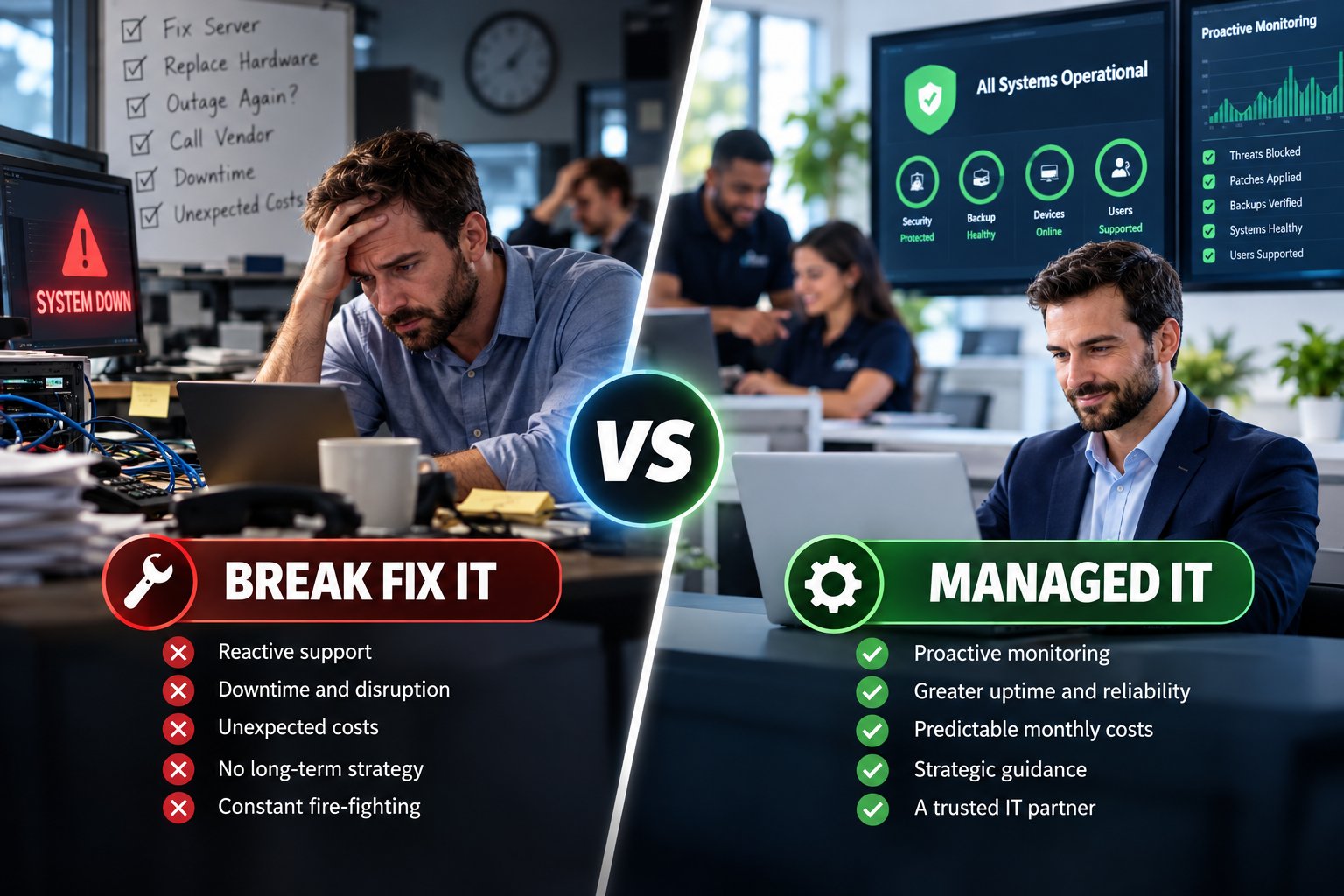
For years, small businesses purchased IT support in much the same way they hired an electrician or plumber.
Something broke.
They called someone.
The technician fixed it.
The business paid for the time.
That model is commonly called break/fix IT.
It can still work in certain situations. But as businesses become more dependent on cloud systems, cybersecurity, remote access, business applications, and digital information, many organizations have moved toward managed IT services instead.
The difference is not simply how the provider sends the invoice.
It is a different operating model.
What Is Break/Fix IT?
Break/fix is fundamentally reactive.
The provider usually becomes involved when the business requests assistance.
Typical examples include:
- a computer will not start
- email stops working
- a printer fails
- an employee cannot connect remotely
- a server develops a problem
- software needs to be installed
The provider performs the work and charges the business, commonly by the hour or by the project.
For very small organizations with simple technology needs, that can be an entirely reasonable arrangement.
There is little fixed monthly expense, and the business pays primarily when support is required.
But that same characteristic creates the model’s principal limitation.
The provider is generally paid after something goes wrong.
What Is Managed IT?
Managed IT changes the relationship.
Instead of waiting for the business to identify every problem, the provider assumes ongoing responsibility for agreed portions of the technology environment.
That may include:
- help desk support
- endpoint management
- patching
- cybersecurity
- network monitoring
- Microsoft 365 administration
- identity management
- backup
- vendor coordination
- technology planning
The provider is generally paid a recurring monthly fee based on the agreed scope.
The objective is not to eliminate every technology problem. No provider can do that.
The objective is to manage the environment continuously enough that many problems can be prevented, detected earlier, standardized, or resolved before they become larger disruptions.
Reactive vs. Proactive Is the Core Difference
Consider a workstation that has not installed operating-system updates for several months.
Under a break/fix relationship, that may not become visible until the computer develops a problem or the customer specifically asks someone to investigate it.
Under a managed model, patching should generally be part of an ongoing process.
The same principle applies to:
- failed backups
- antivirus alerts
- aging hardware
- disk-space problems
- expiring warranties
- user access
- software updates
The managed-services model attempts to identify these conditions before they become emergencies.
That is the conceptual shift.
The Financial Models Are Different Too
Break/fix IT usually creates variable spending.
A quiet month may cost almost nothing.
A month involving a failed server, malware incident, or office move may be expensive.
Managed IT creates a more predictable operating expense because an agreed set of services is included in a recurring fee.
Neither model automatically costs less.
In fact, a business with very few technology problems may spend less in a particular year using break/fix support.
But cost alone does not capture the entire comparison.
Businesses also need to consider:
- downtime
- employee productivity
- cybersecurity exposure
- management time
- preventive maintenance
- vendor coordination
- predictability
The least expensive support arrangement is not necessarily the least expensive technology environment.
Incentives Matter
There is an interesting economic difference between the models.
In a traditional hourly arrangement, more problems generally create more billable work.
In a well-designed managed-services agreement, recurring problems consume the provider’s resources without necessarily creating additional revenue.
That gives the provider a stronger incentive to standardize the environment, automate routine work, and eliminate recurring issues.
This does not mean every MSP automatically operates efficiently or proactively.
But the economic model makes proactive management more compatible with the provider’s interests.
Cybersecurity Changes the Equation
Break/fix support was easier to justify when technology risk was mostly operational.
A computer failed. A printer stopped working. A server needed repair.
Cybersecurity introduces a different problem.
Businesses cannot wait for a security incident and then begin thinking about security.
Controls such as these need to exist before an incident:
- endpoint protection
- email security
- multi-factor authentication
- security monitoring
- patch management
- employee awareness
- backup
- access controls
Cybersecurity is inherently continuous.
That makes it difficult to treat security purely as an occasional repair activity.
Cloud Services Also Require Ongoing Management
Microsoft 365, Google Workspace, cloud applications, and remote work have also changed the nature of IT support.
The technology environment is no longer simply a collection of computers sitting inside an office.
Employees may access business systems from:
- home
- mobile devices
- customer locations
- hotels
- airports
- personal networks
Users join and leave. Applications are added. Permissions change. Licenses accumulate.
These environments benefit from continuous administration rather than occasional intervention.
When Break/Fix Can Still Make Sense
Managed IT is not automatically the correct model for every business.
Break/fix can still make sense when:
- the organization is extremely small
- technology use is simple
- downtime has limited business impact
- there are few regulatory or security requirements
- internal staff already manage most technology
- the business primarily needs occasional technical assistance
A two-person consultancy using a handful of cloud applications may have very different requirements from a 40-person professional-services firm handling sensitive client information.
The operating model should match the risk and complexity of the business.
When Managed IT Becomes More Valuable
Managed services tend to become more attractive as the business develops greater dependence on technology.
Indicators can include:
- more employees
- remote or hybrid work
- multiple business locations
- sensitive information
- cybersecurity requirements
- cloud applications
- industry compliance obligations
- limited internal IT expertise
- significant cost associated with downtime
At some point, technology becomes too important to manage primarily through emergency calls.
Do Not Confuse Managed IT With Unlimited IT
There is another important distinction.
A managed-services agreement does not necessarily mean every conceivable technology activity is included in the monthly fee.
Projects such as these may still be billed separately:
- office relocations
- major cloud migrations
- server replacements
- new network installations
- large software deployments
Businesses should understand exactly what is included and what is considered project work.
This is one reason comparing MSP proposals solely by monthly price can be misleading.
A Useful Way to Think About the Choice
The decision is less about choosing between two IT billing models and more about deciding how much ongoing responsibility the business wants its provider to assume.
Break/fix says:
Call us when you need technical help.
Managed IT says:
We will continuously manage defined parts of the environment and support you when problems arise.
Neither statement is inherently right or wrong.
They simply describe different relationships.
The Bottom Line
For organizations with limited technology dependence, break/fix support may remain perfectly adequate.
But as technology becomes more closely tied to productivity, customer service, cybersecurity, and business continuity, relying entirely on reactive support becomes increasingly difficult.
The more useful question is not:
Which model is cheaper?
It is:
How much business risk are we comfortable managing reactively?
That answer usually makes the appropriate support model much clearer.